GS Federal Insights
Why do new opioids keep showing up, and will our tests catch them?
Why new synthetic opioids keep appearing, what common tests can miss, and what prevention professionals and responders can do.
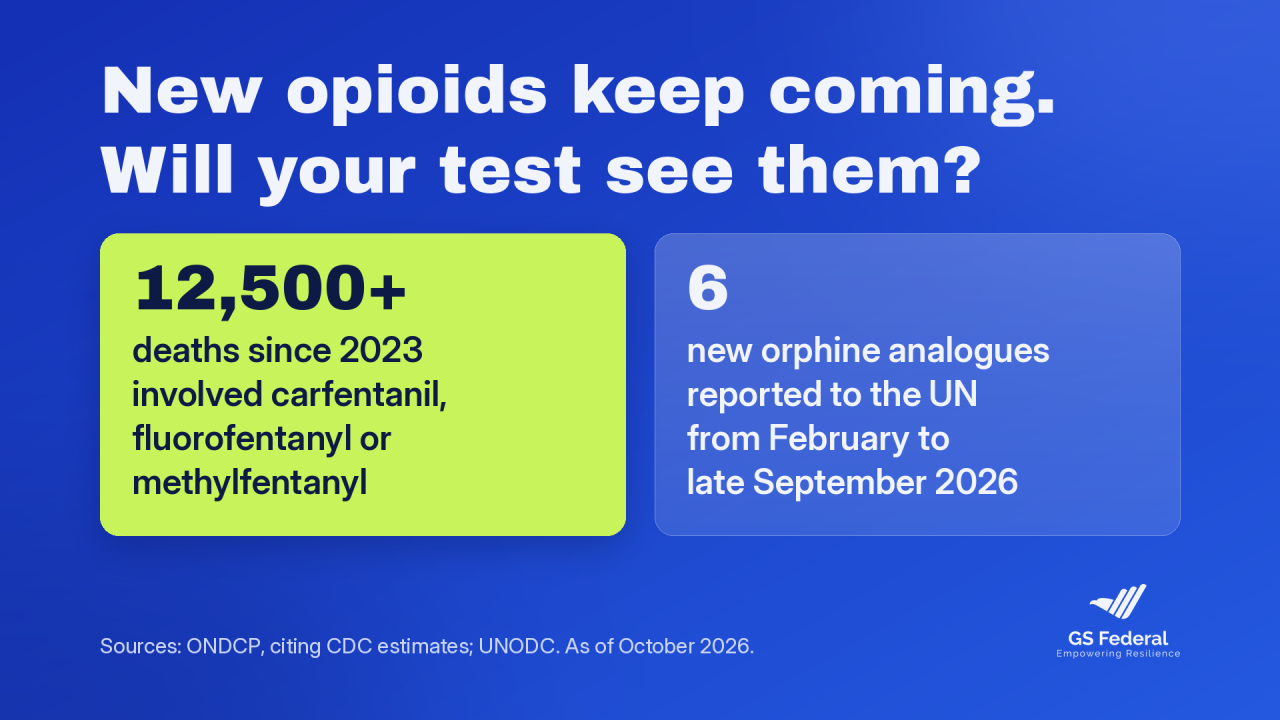
New synthetic opioids keep showing up because when one compound gets controlled, makers move to a close chemical relative, and federal and forensic labs have watched that happen with nitazenes and now orphines. Some of the newest ones won’t show up on a fentanyl test strip or a standard hospital urine screen. Naloxone works on these opioids, though some may take more than one dose, so naloxone should still be administered in the case of an overdose.
Over the years, I have increasingly heard these questions. Here’s what the federal and forensic sources say right now.
What’s a fentanyl analogue, and what’s a novel synthetic opioid?
A fentanyl analogue is a close chemical cousin of fentanyl, changed slightly. Carfentanil, fluorofentanyl and methylfentanyl are examples. Fentanyl-related substances have been federally controlled as a class since 2018.
“Novel synthetic opioid” is a broader label for lab-made opioids that aren’t built on fentanyl’s structure. The two families showing up most right now are nitazenes and orphines. Nitazenes were first studied as painkillers by a Swiss drug company in the 1950s, and orphines trace back to pharmaceutical research in the 1960s and 1970s. None of them is an approved medicine in the U.S.
What did ONDCP’s September 2026 notice find?
On September 15, 2026, the White House Office of National Drug Control Policy (ONDCP) issued a Drug Threat Notice naming carfentanil, fluorofentanyl and methylfentanyl as the greatest fentanyl-analogue threat right now. Citing estimates from the Centers for Disease Control and Prevention, it says these three and their isomers were involved in at least 12,500 deaths since 2023: nearly 12,000 for fluorofentanyl, nearly 600 for carfentanil and about 50 for methylfentanyl.
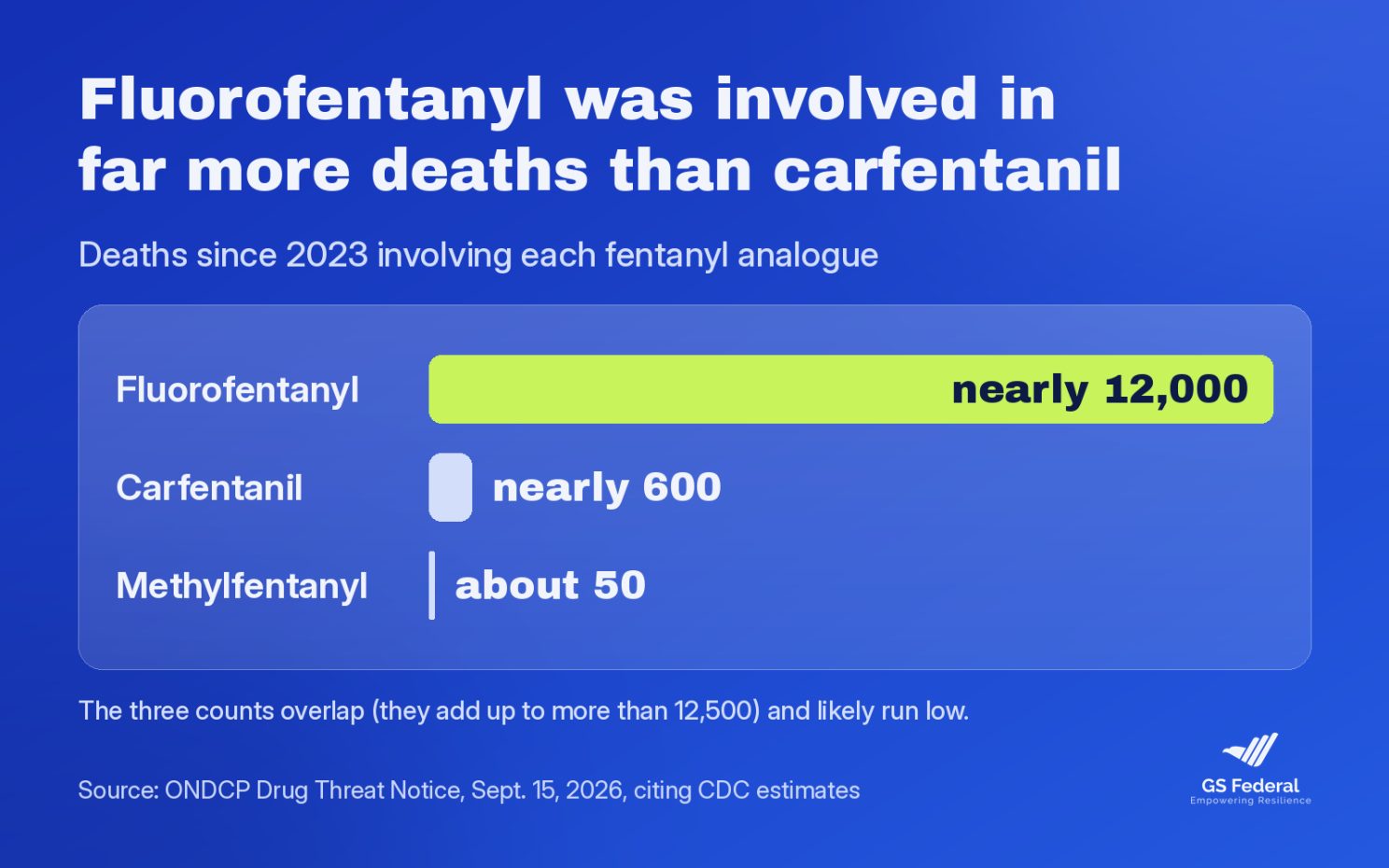
The differences really caught my attention. Carfentanil seems to really get focused on, and ONDCP says it’s 100 times more powerful than fentanyl. Fluorofentanyl, which ONDCP describes as at least as potent as fentanyl, is the one in most of the death count. It seems to be potency that attracts the attention, versus the actual relationship to impact. This is unfortunate.
They’re also widespread. The U.S. Drug Enforcement Administration’s National Forensic Laboratory Information System (NFLIS) found carfentanil and fluorofentanyl in every state except South Dakota and Hawaii in 2025, and methylfentanyl in 36 states. Lab-tested carfentanil samples rose 206% and methylfentanyl samples rose 297% since 2024.
What are nitazenes and orphines, and why does a new one appear when one is banned?
Nitazenes are a family of lab-made opioids. In its May 12, 2026 public safety advisory, DEA said it has reported 22 unique nitazene compounds since 2020, and 21 of them are Schedule I. DEA also wrote that “new nitazenes tend to be introduced when regulatory actions, enforcement, and drug scheduling put pressure on existing analogues.”
Orphines are a second family, named for brorphine, which DEA temporarily placed in Schedule I in 2021. The Center for Forensic Science Research & Education (CFSRE) reported that after China put nitazenes under class-wide control in July 2025, nitazene positivity in its testing fell while orphine positivity rose, led by cychlorphine (N-propionitrile chlorphine). CFSRE says lab (in vitro) data show cychlorphine is about 10 times more potent than fentanyl.
DEA put cychlorphine and three other orphines in temporary Schedule I on August 27, 2026. Its order counts 225 NFLIS reports of cychlorphine in 19 states since 2022, and 49 deaths confirmed through DEA’s toxicology testing program, DEA TOX. In DEA TOX’s second-quarter 2026 report, cychlorphine turned up in 23 cases, and all 23 were fatal. The same report found 5-chloro desmethyl chlorphine, a related orphine that isn’t part of the August order, in six fatal cases.
The cycle keeps going. China announced class-wide control of orphines effective October 1, 2026, and the UN’s drug early-warning system says six new orphine analogues were reported to it between February and late September 2026. In July, CFSRE reported finding plain “orphine,” a parent compound that isn’t scheduled in the U.S., in a test-purchase sample. Temporary scheduling under federal law lasts two years and can be extended one more, which gives DEA time to finish permanent scheduling while the market keeps shifting.

Will a fentanyl test strip or a hospital urine screen catch them?
Often, no. ONDCP’s notice says standard hospital opioid urine screens don’t detect fentanyl analogues. Fentanyl urine screens may pick up some through cross-reactivity, depending on the analogue and the test. ONDCP says fluorofentanyl and methylfentanyl may screen positive, and carfentanil won’t be detected.
For cychlorphine, ONDCP’s April 30, 2026 notice says it isn’t detected by drug test strips or routine hospital opioid urine screens. CFSRE found it was the only opioid in 11 of the 25 fatal cases it tested, so in those cases there was no fentanyl or other opioid for a fentanyl test to find.

That’s one reason ONDCP points hospitals to DEA TOX. Clinicians can ask DEA to test clinical samples that other testing can’t explain. It also means the counts in this article likely run low, because labs can only report what their tests are built to find.
Does naloxone work on them?
Yes. These are opioids, and naloxone reverses opioids. DEA’s May advisory says nitazenes and cychlorphine “might require several doses of naloxone to be effective,” and ONDCP’s September notice tells responders to be prepared to treat opioid overdoses with extra doses.
The complication is what’s mixed in. Sedatives like xylazine and medetomidine aren’t opioids, so naloxone may not fully reverse them. Naloxone should still be administered in the case of an overdose, along with a call to 911.
What can you do now?
-
Carry more than one dose of naloxone, and train people that a second or third dose may be needed.
-
Teach responders and families that a negative fentanyl test strip may miss newer opioids, and that every pill or powder from outside a pharmacy could contain them.
-
If you work with an ED, coroner or medical examiner, share the DEA TOX option for cases routine testing can’t explain.
-
Use plain-language names in trainings (nitazenes, orphines, cychlorphine) so staff recognize them in alerts.
-
Put a standing check of DEA, ONDCP, CDC and CFSRE alerts on your team’s monthly agenda, because the names change fast.
What we don’t know yet
The death counts are almost surely low. Many labs don’t test for these compounds, and DEA’s own order notes that common screening methods may not yet identify the orphines. ONDCP’s 12,500 figure counts deaths where an analogue was involved, often alongside other drugs, and the three totals add up to more than 12,500, so some deaths likely involved more than one. The notice doesn’t give an end date for “since 2023.”
NFLIS counts drugs police seized and labs tested, which tells us what’s in the supply. Use and death counts come from other systems. DEA TOX is a convenience sample of cases clinicians and medical examiners chose to send in. The potency figures come mostly from lab studies. And we don’t know yet which compound will fill the gap after China’s orphine control, or where it’ll show up first.
Sources
Center for Forensic Science Research and Education. (2026, July 20). Orphine [NPS Discovery new drug monograph]. https://www.cfsre.org/images/monographs/Orphine-New-Drug-Monograph-NPS-Discovery.pdf
Controlled Substances Act, 21 U.S.C. § 811(h) (1970). https://www.govinfo.gov/content/pkg/USCODE-2023-title21/html/USCODE-2023-title21-chap13-subchapI-partB-sec811.htm
Drug Enforcement Administration. (2021). Schedules of controlled substances: Temporary placement of brorphine in schedule I. Federal Register, 86, 11862–11867. https://www.federalregister.gov/documents/2021/03/01/2021-04242/schedules-of-controlled-substances-temporary-placement-of-brorphine-in-schedule-i
Drug Enforcement Administration. (2025). Schedules of controlled substances: Temporary placement of ethyleneoxynitazene, methylenedioxynitazene, 5-methyl etodesnitazene, N-desethyl etonitazene, N-desethyl protonitazene, N,N-dimethylamino etonitazene, and N-pyrrolidino isotonitazene in schedule I. Federal Register, 90, 48259–48266. https://www.federalregister.gov/documents/2025/10/15/2025-19542/schedules-of-controlled-substances-temporary-placement-of-ethyleneoxynitazene-methylenedioxynitazene
Drug Enforcement Administration. (2026, May 12). Heightened threat: Fentanyl mixed with emerging synthetic drugs [Public safety advisory]. https://www.dea.gov/press-releases/2026/05/12/public-safety-advisory
Drug Enforcement Administration. (2026). Schedules of controlled substances: Temporary placement of 5,6-dichloro brorphine, 5,6-dichloro desmethylchlorphine, N-propionitrile chlorphine, and spirochlorphine in schedule I of the Controlled Substances Act. Federal Register, 91, 55252–55258. https://www.federalregister.gov/documents/2026/08/27/2026-17531/schedules-of-controlled-substances-temporary-placement-of-56-dichloro-brorphine-56-dichloro
Drug Enforcement Administration, Diversion Control Division. (2026). DEA TOX quarterly report: 2026 second quarter. DEA Toxicology Testing Program. https://www.deadiversion.usdoj.gov/dea_tox/quarterly_reports/2nd_Quarter_2026_DEA_TOX.pdf
Krotulski, A. J., Papsun, D. M., Stang, B. N., Walton, S. E., & Logan, B. K. (2026). Increase in fatal overdoses linked to novel synthetic opioid N-propionitrile chlorphine (cychlorphine) [Public alert]. Center for Forensic Science Research and Education. https://www.cfsre.org/nps-discovery/public-alerts/increase-in-fatal-overdoses-linked-to-novel-synthetic-opioid-n-propionitrile-chlorphine-cychlorphine
Office of National Drug Control Policy. (2026, April 30). ONDCP drug threat notice: Cychlorphine, a synthetic opioid involved in at least 55 deaths, has potential to spread across nation. Executive Office of the President. https://www.whitehouse.gov/wp-content/uploads/2026/09/Drug-Threat-Cychlorohine-justified-1-1.pdf
Office of National Drug Control Policy. (2026, September 15). ONDCP drug threat notice: Key fentanyl analogues, involved in at least 12,500 deaths since 2023, pose heightened threat to nation. Executive Office of the President. https://www.whitehouse.gov/wp-content/uploads/2026/09/Drug-Threat-fentanyl-analogues-1.pdf
United Nations Office on Drugs and Crime. (2026, September 30). September 2026: China introduces class scheduling of orphine analogues. UNODC Early Warning Advisory on New Psychoactive Substances. https://www.unodc.org/LSS/Announcement/Details/b83bbce5-7445-4b69-91f5-c4fddd0d134d
By Greg Pliler. Facts and sources current as of October 4, 2026.