
PreventionCoach.ai Insights
November 12th and December 11th: Important dates for hemp and THC products.
What changes in the federal hemp definition on November 12 and December 11, 2026, and what those dates mean for prevention and community education.
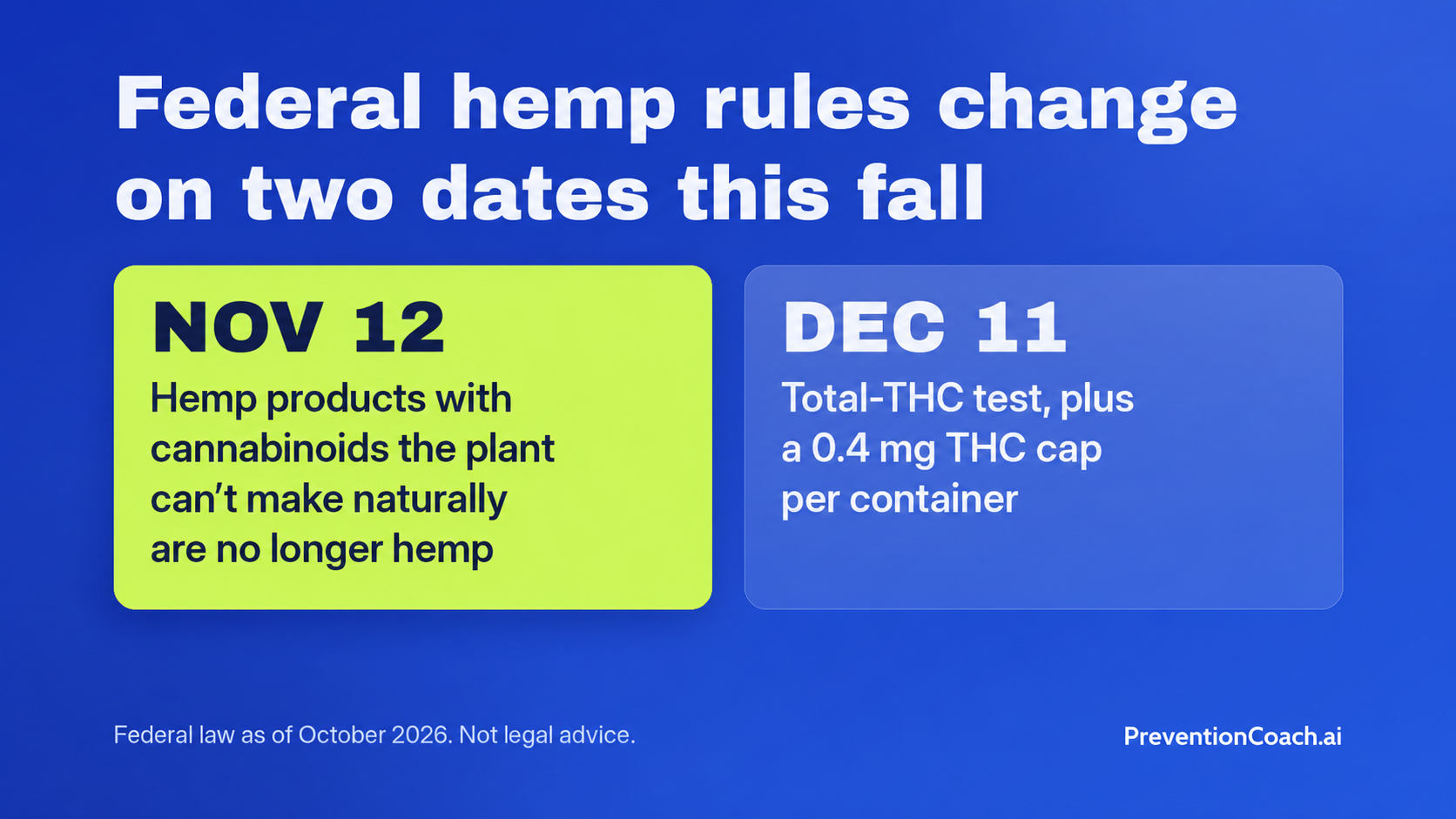
On November 12, 2026, hemp-derived products made with cannabinoids the cannabis plant can't produce naturally drop out of the federal definition of hemp. On December 11, 2026, the rest of the new definition takes effect, including a total-THC test that counts THCA and a cap of 0.4 milligrams of total THC (plus similar cannabinoids) per container for finished products. Anything that falls outside "hemp" is treated as marijuana under the Controlled Substances Act.
I expect coalitions, DFC grantees, retailer-education programs and parents to ask about these dates between now and December, so here's what federal law says, in order. This covers federal law only, as of early October 2026. This isn't legal advice, and state laws differ, so check with your state agency or legal counsel before you act on any of it.
What counts as hemp today?
Since the 2018 Farm Bill, hemp has meant the Cannabis sativa L. plant and its derivatives, extracts and cannabinoids with no more than 0.3% delta-9 THC on a dry weight basis. Hemp was taken out of the federal definition of marijuana, and THC in hemp was exempted from Schedule I. For most products, that 0.3% delta-9 test stays in place through December 10, 2026.
Two federal positions are important to consider alongside that definition. The U.S. Drug Enforcement Administration has said since its 2020 rule implementing the Farm Bill that synthetically derived THC remains in Schedule I. Its May 4, 2026 final rule listing HHC by name in Schedule I adds that THC "produced through chemical conversion, even when hemp derived," doesn't qualify as THC in hemp. In a 2022 trademark case, the Ninth Circuit read the 2018 definition the other way for delta-8 on the record in front of it, so the federal status of converted products stays contested until the new definition applies.
The U.S. Food and Drug Administration has its own important viewpoint. FDA's position is that THC and CBD can't be sold as dietary supplements or added to food in interstate commerce, and it says delta-8 THC products "have not been evaluated or approved by the FDA for safe use in any context."
What changes on November 12?
Congress rewrote the hemp definition in Public Law 119-37 (section 781), signed November 12, 2025, effective 365 days later. On September 2, 2026, Public Law 119-103 (section 2019) narrowed what applies on that first date.
From November 12 through December 10, only one piece of the new definition is live. Intermediate and final hemp-derived cannabinoid products that contain cannabinoids "not capable of being naturally produced by a Cannabis sativa L. plant" are no longer hemp. The Congressional Research Service says that starting November 12, those products "are to be classified as marijuana under the CSA."
Which cannabinoids fall in that group isn't fully settled. The 2025 law told FDA to publish, within 90 days, a list of cannabinoids the plant can produce naturally, a list of THC-class cannabinoids, and a list of cannabinoids with similar effects. CRS reported that those lists hadn't been published as of September 28, 2026. Until they are, I'd be careful about telling a store owner or a parent that a specific product on the shelf is or isn't affected on November 12.
What changes on December 11?
On December 11, the rest of section 781 applies, unless Congress acts again.
The plant test changes to total THC, including THCA, at no more than 0.3% on a dry weight basis. That matters for "THCA flower," because the current statutory test counts delta-9 only. (Growers have already had to report total THC for USDA compliance testing since 2021.)
Products made with cannabinoids the plant does produce, but that were "synthesized or manufactured outside the plant," are excluded. FDA says concentrated delta-8 is typically made by chemically converting hemp-derived CBD. Delta-8 made that way would generally fall under this exclusion, though the FDA lists mentioned above will settle which cannabinoids count as naturally produced.
Intermediate products, the ingredients that go into finished goods, are excluded if they contain more than 0.3% combined total THC and other cannabinoids with similar effects, as determined by HHS, or if they're marketed or sold directly to consumers.
Finished products are excluded if they contain more than 0.4 milligrams combined total per container of total THC and similar-effect cannabinoids. The law defines "container" as the innermost package in direct contact with the product, such as a jar, bottle, bag, can, carton or cartridge. So the cap applies to the whole package, however many servings are inside.
Two things stay in. Industrial hemp (fiber, grain, seed oil and similar uses, plus microgreens and research plants) is written into the definition, and FDA-approved drugs aren't treated as hemp-derived cannabinoid products.
Didn't marijuana get rescheduled?
Partly, and the order says it doesn't apply to hemp. On April 28, 2026, the U.S. Department of Justice published a final order moving marijuana, marijuana extract and naturally derived delta-9 THC to Schedule III only when they're in an FDA-approved product or covered by a state medical marijuana license. Outside those two situations, they stay in Schedule I. The order states that it "does not affect the status of hemp" and that "synthetic THC remains in schedule I."
So a product that falls outside the hemp definition on November 12 or December 11 becomes marijuana under federal law, which is Schedule I unless one of those two conditions applies.
The broader 2024 proposal to move marijuana to Schedule III hasn't been finalized. DEA's administrative law judge held the hearing from June 29 to July 15, 2026. On September 29, the Chief ALJ stayed the case while he considers a motion to add a September 23 GAO report on drug scheduling to the record. The government's response is due October 13, and the order doesn't set a date for a decision.
What does this mean for youth prevention and community education?
The National Institute on Drug Abuse (NIDA) notes that delta-8 products may be sold online or in gas stations and convenience stores, and it reported that about 11% of 12th graders said they'd used delta-8 THC in the past year in the 2023 Monitoring the Future survey.
Data from the Centers for Disease Control and Prevention add some context. In a September 2026 MMWR covering 31 states and DC from January 2021 to June 2025, delta-8 THC was found in 1.1% of the 43,880 overdose deaths where cannabis was detected. CDC notes that postmortem screening tests can't tell delta-8 from delta-9 without confirmatory testing, so I'd read that number with care.
For prevention work, I'd keep the message steady through the transition. The federal change is about how these products are classified. The health information we already share about THC and young people still applies on November 12, on December 11, and after. State rules and timelines vary, so I'd expect some confusion in communities.
What can you do now?
Put November 12 and December 11 on your calendar, and re-check both dates the week before each one. Congress could still change them.
Update training slides and fact sheets that say "hemp is 0.3% delta-9 THC" so they carry a date.
Ask your state agency how your state is handling the change, and point retailers and the public to your state regulator for compliance questions.
In retailer and parent education, explain what the federal definition says and avoid ruling on specific products.
Keep youth messaging focused on health and age, so it holds up whatever happens with the dates.
What don't we know yet?
We don't know whether Congress will move the dates again. CRS lists introduced bills that would delay the new definition two more years (H.R. 7024, H.R. 7010 and S. 3686) or repeal it (H.R. 6209), and others that would replace it with a different framework. None had been enacted as of CRS's September 28 update, and the House-passed FY2027 agriculture spending bill doesn't include a delay. December 11 is also the date the current continuing resolution runs out, so the next funding bill is worth watching.
We also don't know when FDA will publish the cannabinoid lists or more detail on "container," how HHS will define "similar effects," how federal and state enforcement will look after each date, or how the stayed rescheduling case will come out. I'll update this article if any of that changes before December.
Sources
Agriculture Improvement Act of 2018, Pub. L. No. 115-334, § 10113, 132 Stat. 4490 (2018). https://www.govinfo.gov/content/pkg/PLAW-115publ334/html/PLAW-115publ334.htm
AK Futures LLC v. Boyd Street Distro, LLC, 35 F.4th 682 (9th Cir. 2022). https://cdn.ca9.uscourts.gov/datastore/opinions/2022/05/19/21-56133.pdf
Continuing Appropriations, Agriculture, Legislative Branch, Military Construction and Veterans Affairs, and Extensions Act, 2026, Pub. L. No. 119-37, div. B, § 781, 139 Stat. 558 (2025). https://www.govinfo.gov/content/pkg/PLAW-119publ37/html/PLAW-119publ37.htm
Continuing Appropriations and Extensions Act, 2027, Pub. L. No. 119-103, div. B, § 2019 (2026). https://www.govinfo.gov/content/pkg/PLAW-119publ103/html/PLAW-119publ103.htm
Drug Enforcement Administration. (2020). Implementation of the Agriculture Improvement Act of 2018 [Interim final rule]. Federal Register, 85, 51639–51645. https://www.federalregister.gov/documents/2020/08/21/2020-17356/implementation-of-the-agriculture-improvement-act-of-2018
Drug Enforcement Administration. (2026). Specific listing for hexahydrocannabinol, a currently controlled schedule I substance [Final rule]. Federal Register, 91, 23913–23915. https://www.federalregister.gov/documents/2026/05/04/2026-08595/specific-listing-for-hexahydrocannabinol-a-currently-controlled-schedule-i-substance
Julius, D. C. (2026, September 29). Order staying case and ordering response to motion (DEA Docket No. 1362, Hearing Docket No. 26-96). Drug Enforcement Administration, Office of Administrative Law Judges. https://ndasa.com/wp-content/uploads/2026/09/Proposed-Marijuana-Rescheduling_Stay-and-Briefing-Order.pdf
National Institute on Drug Abuse. (2024, March 12). Delta-8-THC use reported by 11% of 12th graders in 2023 [News release]. https://nida.nih.gov/news-events/news-releases/2024/03/delta-8-thc-use-reported-by-11-of-12th-graders-in-2023
Neuhofer, Z. T. (2026, September 28). Changes to the statutory definition of hemp and implications for agricultural policy (CRS Report No. IF13136). Congressional Research Service. https://www.congress.gov/crs-product/IF13136
Tanz, L. J., Quader, Z. S., Mattson, C. L., & Vivolo-Kantor, A. M. (2026). Notes from the field: Cannabis detection among overdose deaths, United States, 2021–2025. MMWR. Morbidity and Mortality Weekly Report, 75(34), 539–541. https://doi.org/10.15585/mmwr.mm7534a2
U.S. Department of Agriculture, Agricultural Marketing Service. (2021). Establishment of a domestic hemp production program [Final rule]. Federal Register, 86, 5596–5691. https://www.federalregister.gov/documents/2021/01/19/2021-00967/establishment-of-a-domestic-hemp-production-program
U.S. Department of Justice. (2024). Schedules of controlled substances: Rescheduling of marijuana [Proposed rule]. Federal Register, 89, 44597–44622. https://www.federalregister.gov/documents/2024/05/21/2024-11137/schedules-of-controlled-substances-rescheduling-of-marijuana
U.S. Department of Justice. (2026). Schedules of controlled substances: Rescheduling of Food and Drug Administration approved products containing marijuana from schedule I to schedule III; corresponding change to permit requirements. Federal Register, 91, 22714–22723. https://www.federalregister.gov/documents/2026/04/28/2026-08176/schedules-of-controlled-substances-rescheduling-of-food-and-drug-administration-approved-products
U.S. Food and Drug Administration. (n.d.). 5 things to know about delta-8 tetrahydrocannabinol (delta-8 THC). https://www.fda.gov/consumers/consumer-updates/5-things-know-about-delta-8-tetrahydrocannabinol-delta-8-thc
U.S. Food and Drug Administration. (n.d.). FDA regulation of cannabis and cannabis-derived products, including cannabidiol (CBD). https://www.fda.gov/news-events/public-health-focus/fda-regulation-cannabis-and-cannabis-derived-products-including-cannabidiol-cbd
Keep exploring.
Read other Insights